
Traditional SEO usually involves making certain pages on a website very appealing in order for the search engines to rank them higher and users to organically find and click on them.
Typically, the pages are made to target certain keywords, and then they fight for a ranking position among Google’s conventional results. SEO relied on this on-page SEO optimization with keyword targeting, together with link-building, as a means to bring in traffic.
Then again, AEO is about making the content suitable for AI-powered answer systems that give direct information synthesis. In fact, the content has to be the one picked, mentioned, and properly represented in the AI-generated answers from tools, versus only ranking.
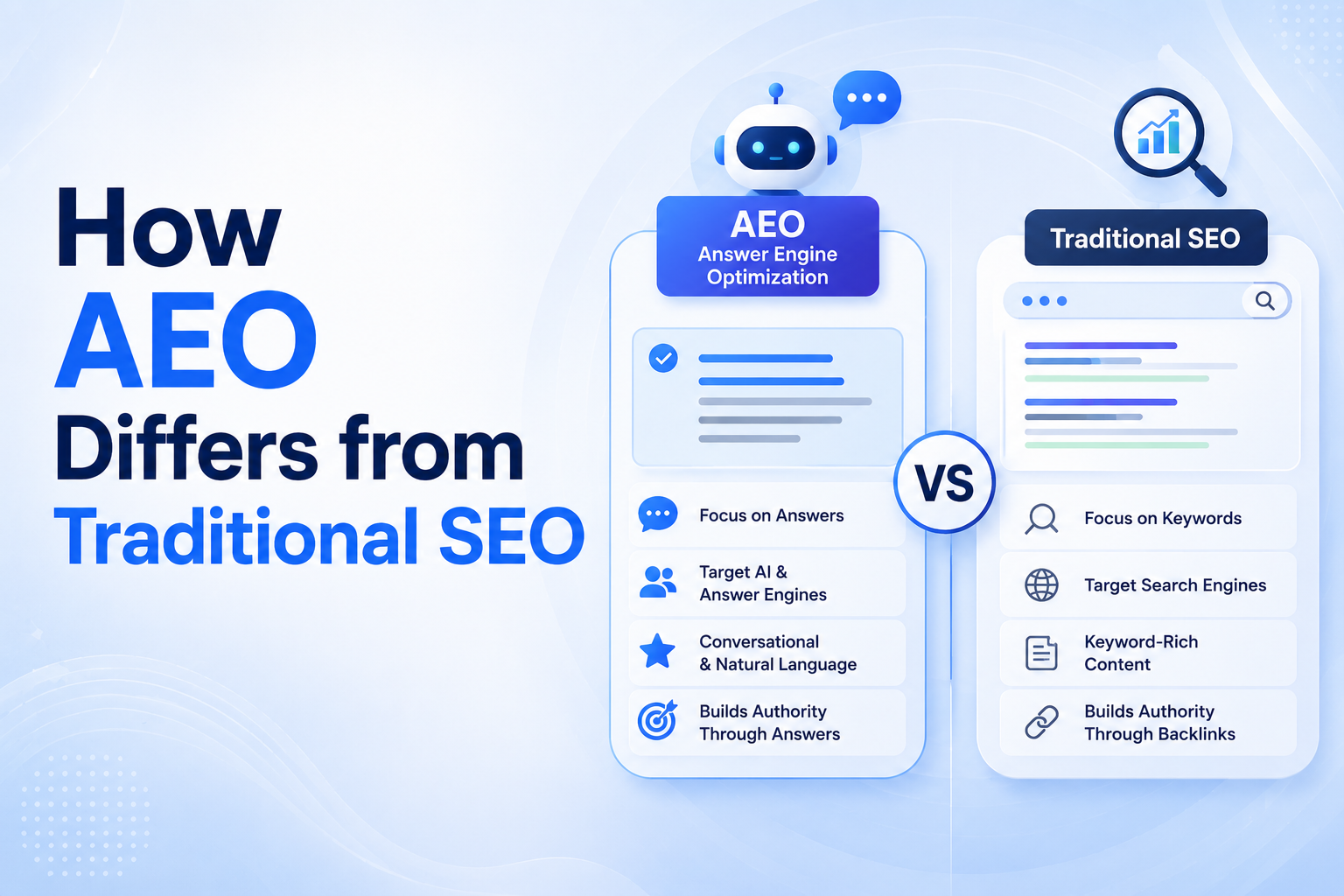
So, the major difference between AEO and SEO is that AEO is more concerned with the correct brand representation in the AI-synthesized answers. At the same time, SEO is only about achieving good search rankings.
SEO is basically working on getting a very high ranking on the three-letter abbreviation SERP through the use of certain keywords and by getting backlinks. In contrast, AEO revolves around the selection of the content and the representation of the brand in the AI answers. Link building has a very marginal role in AEO. AEO is very much about the ways in which the content is turned out, understood, and recapitulated by the AI systems.
Key differences include:
- SEO: AI systems extract and cite your content within synthesized answers, often without a direct click
- AEO: Prioritizes extractable answers and machine-readable clarity
- Content comprehension: AI will clearly check content meaning, and not simply keyword density
- Entity recognition: Easily readable definitions of individuals, products, and correct concepts can help with easy citations
- Structured data and context: Schema for usage, correct headings, and semantic hierarchy are prioritized than sheer volume of contents
Here’s a table that clearly illustrate the key differences between SEO and AEO:
| Aspect | SEO (Search Engine Optimization) | AEO (Answer Engine Optimization) |
| Primary Goal | Drive clicks to your website | Get cited in AI-generated answers |
| Traffic Focus | Click-through rate (CTR) from search results | Visibility and brand authority in AI responses |
| Content Format | Long-form, comprehensive articles (2,000-5,000 words) | Concise, direct answers (50-100 words upfront) |
| Keyword Strategy | Short, fragmentary keywords (e.g., “roulette strategy”) | Question-based, conversational queries (e.g., “what’s the best roulette strategy for beginners?”) |
| Ranking Factors | Backlinks, keyword density, page speed | Authority, content clarity, entity relationships, structured data |
| Measurement | Impressions, clicks, rankings, traffic via Google Search Console | AI citation rate, Google AI Overview appearances, Perplexity citation frequency |
| Content Structure | Broad headers (Introduction, Benefits, Conclusion) | Question-based headers (H2, H3) matching user queries |
| Linking Strategy | Internal linking for navigation, external backlinks for authority | Entity linking to connect related concepts logically |
| Update Frequency | Content can remain relevant for months/years with minimal updates | Regular updates every 3-6 months for freshness |
| Authority Building | Backlinks from reputable sources | Expert credentials, original research, citations from trusted sources |
| Best For | Traditional search traffic, brand awareness through clicks | AI-powered search, trust building without clicks |
| Tools Used | Google Search Console, Ahrefs, SEMrush, Moz | AEO Tracker, Citation Monitor, AI Search Analytics |
