

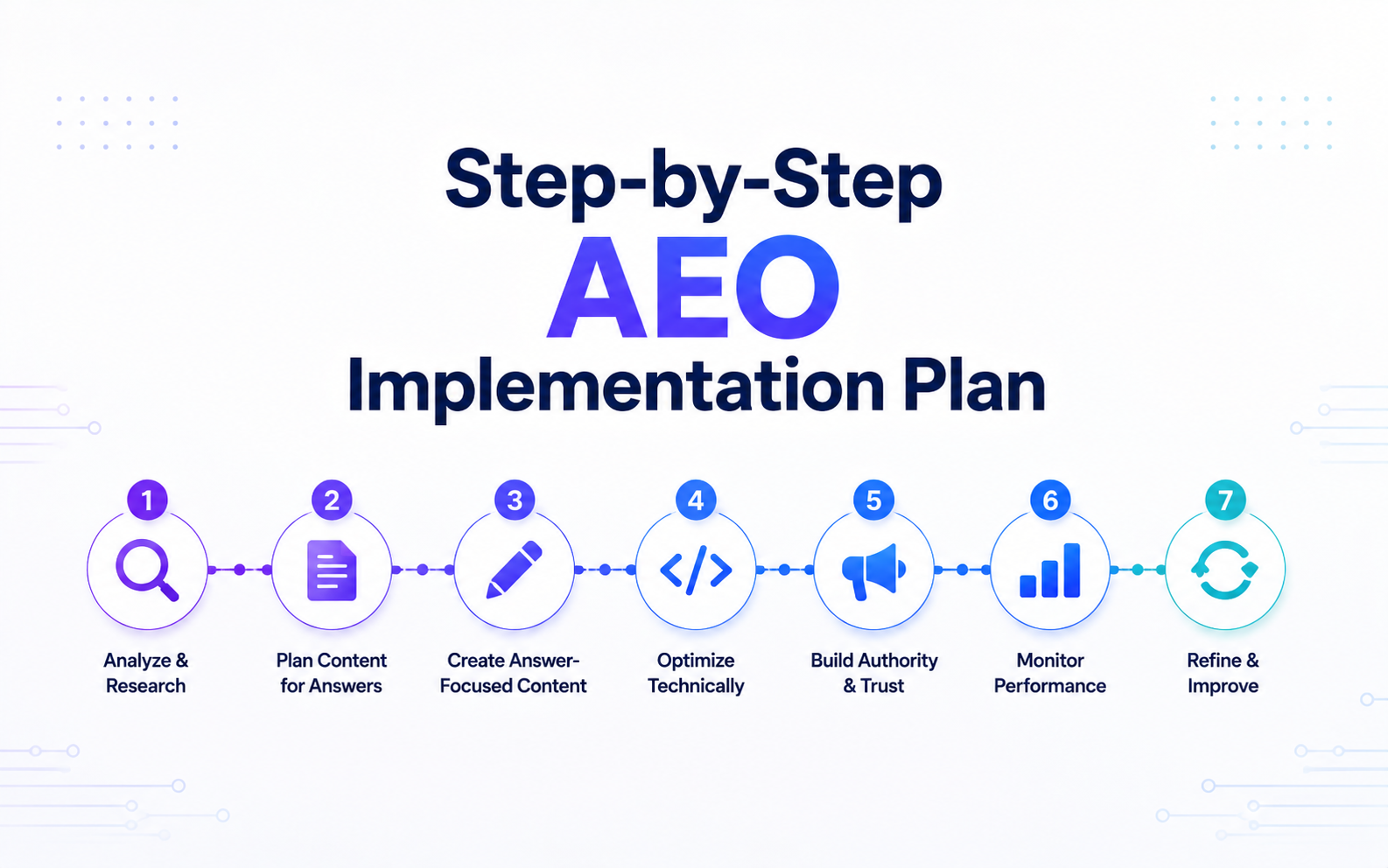
Phase 1: Audit and Assessment (Weeks 1 to 2)
Current Content Examination: Audit your available content for AEO preparedness. You must test every article for whether it has a direct answer in the first 100 words and header areas that are questions. Also, look for clearly defined entities, schema markup, and novelty.
Competitor AEO Analysis: Select your top 5 competitors. Type in the queries they target. Count how many citations they have per query. Note which content forms get the most citations.
Gap Identification: Determine your citation frequency mismatch with that of competitors. Identify content gaps, i.e., questions AI frequently gets answers for, and you have no content for. Start by addressing the large-gap topics.
Phase 2: Content Optimization (Weeks 3 to 6)
Rewrite The Content You Have For Answers: Re-upload your best 10 articles for AEO. Insert direct answers in the first 100 words, turn headers into questions, properly define entities, add bullet points and tables, and apply FAQ schema. AEO is mainly about articulation and structure.
Create New FAQ or How-To Content: Upload 5 to 7 new FAQ pages or some how-to guides covering high-frequency queries. Each content can have 10 to 15 questions with short answers, FAQ schema, and scannable formatting.
Add Structured Data: Add schema markup to all optimized content. Use schema generators and validate. In fact, structured data is more important than the amount of content.
Phase 3: Authority Building (Weeks 7 to 12)
Earn External Citations: Get your guest posts published on 3 to 5 valid sites in your niche. Write articles that answer common questions. Put links to your optimized content. External citations raise your authority.
Publish Original Research: Develop 1to 2 original research documentations. Research that is original is that which gets citations.
Build Expert Credentials: Add features that present authority, like credentials, certifications, and experience, to author bios. Also, add profile photos, links to professional profiles, and make credentials stand out on articles. Focus is on producing content that is trustworthy and knowledgeable.
Phase 4: Monitoring and Iteration (Continuous)
Track Citation Metrics: Run citation tracking tools every week. Log citation frequency, types of queries, and trends. See which content gets the most citations.
Adjust Based On Performance: Focus more on well-performing content types. Rework low-performing articles so they provide better answers. Try different question formats and see which ones lead to citation increases.
Update Content Regularly: Maintain the overall content systematically. Incorporate updated statistics, add new examples, and revise claims that have become stale. Fresh content helps maintain the trust score.
Real-World AEO Case Studies
Bupa: This UK healthcare provider achieved success using UltraScout AI’s AEO services. They secured a dominant number 1 position in AI answers, performing 4x ahead of competitor AXA Health with $10,630 per month in visibility value.
HSBC UK: HSBC achieved 36% Share of Voice across thirty questions tested. The company secured the number 1 spot in the UK;s banking sector. They now lead competitors Lloyds and Barclays with £5,625 per month in AI visibility value.
Avanti West Coast: This rail operator secured the number 1 position for London-Scotland routes with a 70% first-place rate. It even generated $15,620 per month in value.
Contently Strategic Services: A mid-market SaaS client added Contently’s LLM Optimization Blueprint covering schema engineering, entity audits, and conversational-prompt testing in March 2025. They recorded a 42% lift in AI-generated referral traffic within 30 days.
Brainlabs: The “AI Search Lab” of Brainlabs combines log-file analysis, structured-data sprints, and hourly AI-Overview scrapes to optimize for AI-generated answers.
Passion Digital: Passion’s AI SEO & GEO team pairs predictive forecasting with automated prompt creation to keep brands present in ChatGPT, Gemini, and Copilot answers.
